Cumberland, Md. – Every now and then, you run across a car that just reaches out and grabs your attention, and you just can’t figure out why it’s different than all the other top-quality rides that are surrounding it at the show. Johnny Duncan’s ‘55 Chevy is a perfect example of that phenomenon. When I asked Duncan to tell me more about his car, it became obvious that what sets it apart is the attention to detail included in the build.

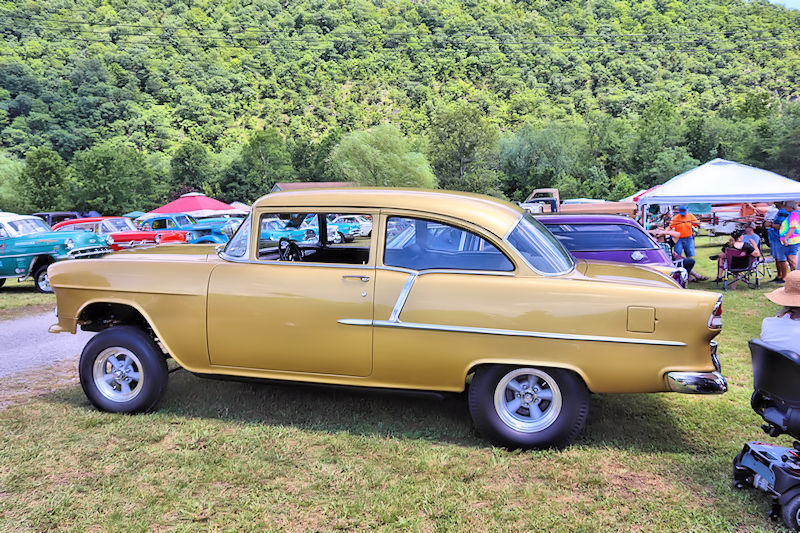
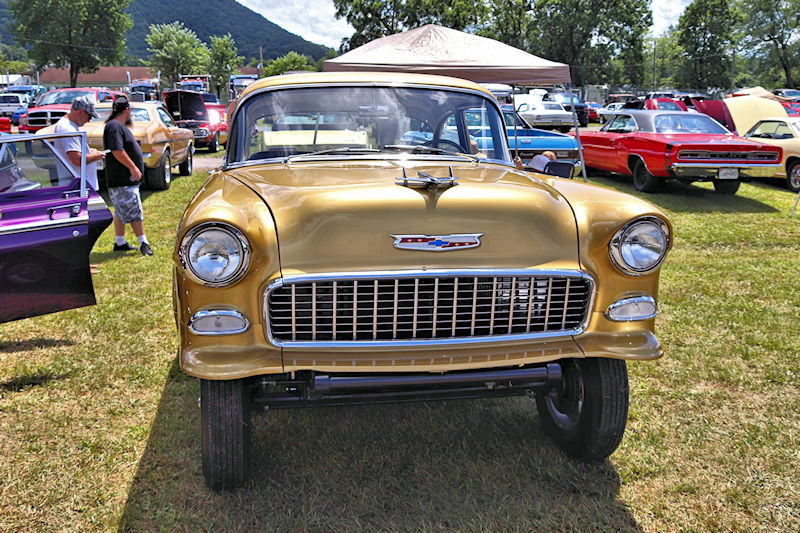
The car, itself, is a 1955 Model 210 Chevrolet. It’s a father-son build that was built up from a bare shell. An amazing part of the car’s story is that it was a survivor of a garage fire. Duncan relates it took them six years to build it the first time, than about another two years to fix it from the fire. Windows from the garage fell through the front clip, so they had to dismantle the car. All the chrome on the car was ruined in the fire. They had to repaint the front clip and replace the headliner. Amazingly, they were able to save the seats and able to save the paint from the firewall back.
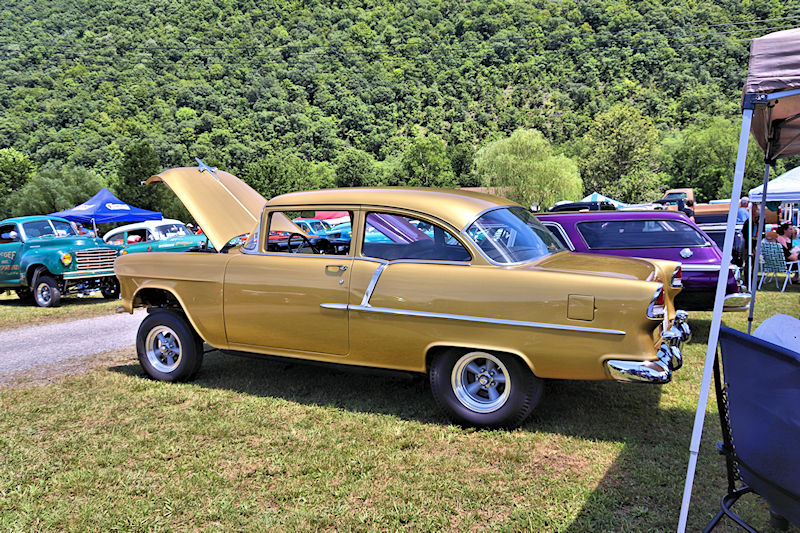
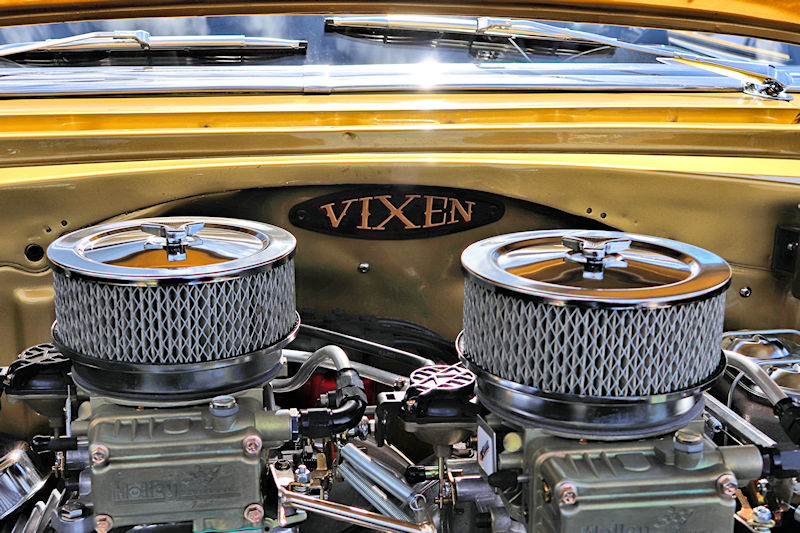
Under the hood of the car is a 489 cu. in. Big Block Chevy engine, equipped with a roller cam, and backed by a Muncie 4-speed transmission (shifted with a Hurst Ram Rod inline shifter) with a 4:11 Ford 9-inch differential. If the first thing you look at is the engine, you’ll start to see some of the subtle details of the build when you look at the induction. According to Duncan, “It’s a polished cross ram, those are neat, you don’t see them too often. It can be a little tricky to run. On this one, the plenums are separated, they don’t have a shared plenum. This carburetor’s feeding 4 cylinders on this side and that carburetor’s feeding 4 cylinders over here and they’re completely independent of one another, so you’re trying to time two 4-cylinder motors together, so that was tricky.”
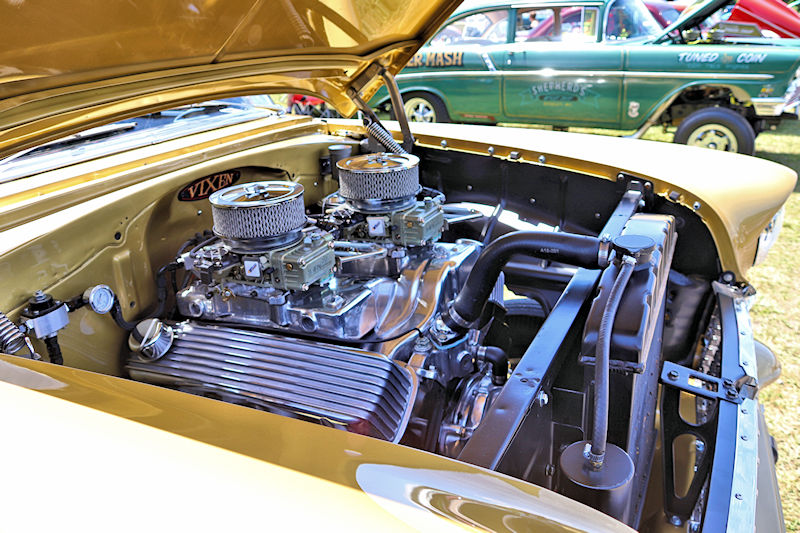

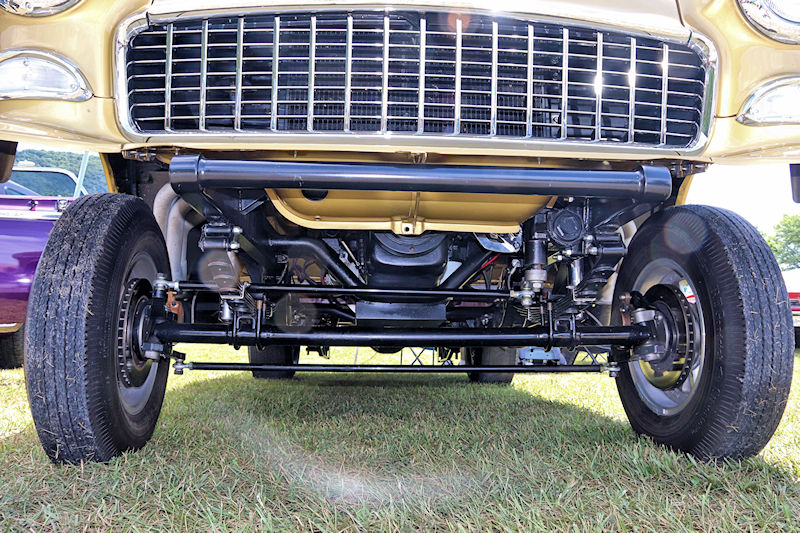
The craftsmanship on this build is impressive and the Duncans are responsible for nearly all of it. They designed and built the front sub-frame, did all the metal work, all the paint work, did all the rust repair underneath on a rotisserie, and painted the underneath. Usually, you don’t think of the sub frame of a car as an area for special details, but this mostly-hidden part of the car came with a lot of thought put into it. Duncan pointed out, “When we laid out the frame rails, we wanted it so when you looked you wouldn’t see anything. You don’t see brake lines, you don’t see bolts, you don’t see fittings. We set the ride height up so everything’s level, the steering links, drag links, everything’s parallel on the front suspension.” Duncan added other details, “ I painted it myself, it’s ‘65 Tiger Gold. We drew up the upholstery for the upholstery shop. The upholstery is from a new Tesla. The company I work for manufactures that material, so we used that to do the car. It’s a fun street car, we enjoy going out to the events and we host Full Throttle Performance Car Club, it’s our car club, and we host charity car shows so I always take it to that. It was a fun build. The car rides and drives and handles nice. The front steering is a Vega box, [with a] shorter column.” I was curious about what kind of miles per gallon this setup achieved, and was amazed when Duncan responded it got 10-11 miles per gallon when last checked, a very impressive feat for that kind of power. The proverbial cherry on the top of this very streetable hot rod is the green LED lights in the dash coupled with green footwell lights that give off a green glow when driving at night.


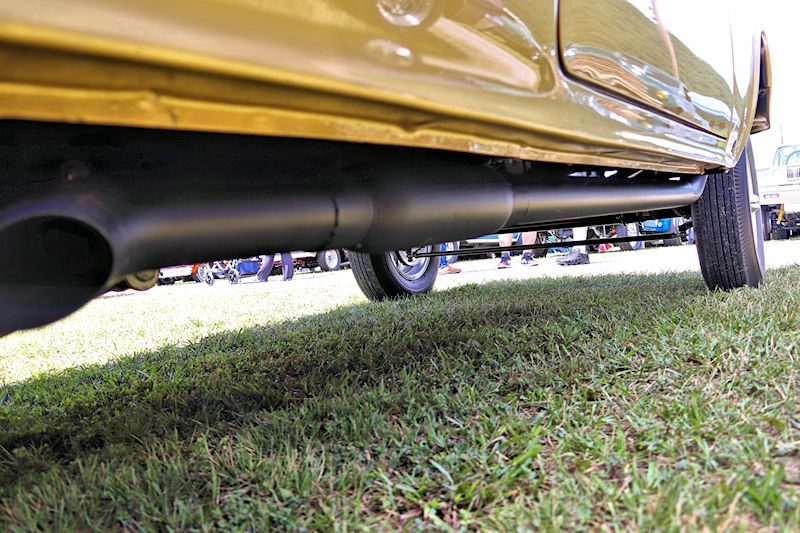
I asked Duncan about the special subtle touches they added to the car that aren’t readily apparent and he enthusiastically listed a bunch that help set the car apart from others. “There’s a lot of subtle touches. We did away with the vent windows, there are no knobs in the dash, it has electric wipers, but the wiper switch is up under the dash, we tried to hide all the wiring. The MSD box is hidden, the coil is hidden. We shortened the collectors in the headers so we could tuck the exhaust. If you get down, you can see the exhaust tucked up under the rockers. That’s coated matte black so it kind of hides. We moved the leaf springs into the frame, so we could get the bigger tires. On the front axle, we changed the way the axle mounts to the frame. We never really liked the look of the square u-bolts on the straight axles , so we used a trailer setup, we used the trailer u-bolts and got it to look more old-school. You don’t see the gold-anodized Speedway u-bolts. We scalloped the inner fenders to fit the header tubes so it’s not just whacked out. There’s a low-mount alternator, painted the aluminum heads black, so you don’t see them. We wanted it to look more traditional. It’s not a period correct car, but it kind of has the look. It has a hydraulic clutch so we changed the reservoir to something that looks not like a plastic container. We tried to run the fuel lines so there’s nothing in the front of the motor, black pulleys, mostly kind of understated.”
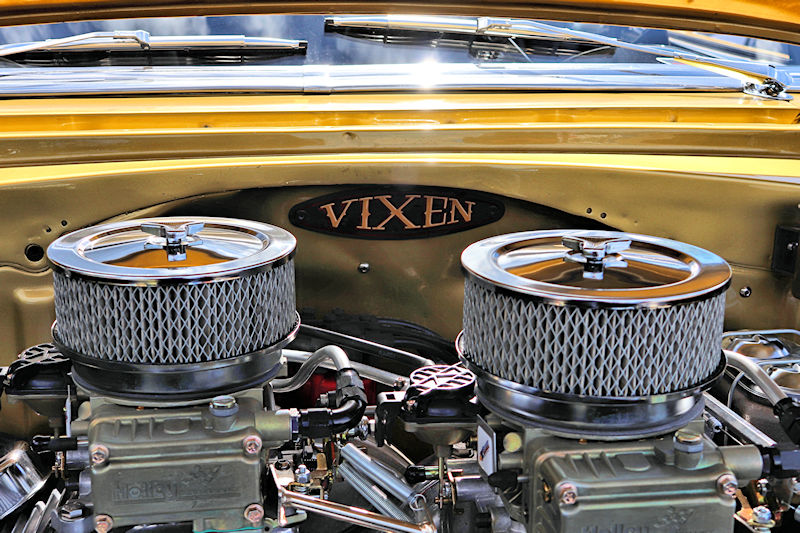
Under the hood, the word “Vixen” is on the firewall, seemingly standing guard over the engine. I wondered what that was all about, and Duncan, probably sensing that curiosity, explained, “The car’s named Vixen. I was at home one Saturday morning, and I was laying under the car block sanding the quarter panel, and I thought to myself, ‘I’ve got my hands on this car more than I do my wife’ so that morning, I said to my dad, ‘okay, her name’s Vixen, this is our girlfriend here.’ He owned the car for about a day and we cut the quarter panel in half took a body saw to it.” It’s impossible not to be more amazed by this car the more you look at it. It’s obvious Johnny Duncan and his father have, indeed, spent a lot of time and love on this “Vixen.”

 DF Motorsports Magazine
Leave a comment